
Not All Maca Is Created Equal – And Neither IsYour Midlife Body
What I Discovered Switching from Single-Color to Tri-Blend Maca at 52 (And Why It Matters for Cycle Support, Brain Focus, and Keto-Ayurvedic Living)
By Kimberly Curtis | futurefocusfemale.com | April 2026
I am going to be honest with you. I went down a rabbit hole this week.
It started with a simple question: is the maca I have been taking actually the best maca for where I am right now? I have been using NOW Foods Maca – a solid, clean, single-color yellow root supplement – and it has served me well. But as I built out content on maca color differences for the community, something clicked. I realized I had been taking a general-purpose tool when what my body at 52 might actually need is a more targeted one.
So I researched. Compared. Questioned. And made a switch – from NOW Foods yellow maca to NaturaLife Labs Organic Tri-Color Maca (Black, Red, and Yellow). Here is everything I found, and why I think this information could be genuinely important for women navigating midlife while trying to protect their cycles, their hormones, and their minds.
First: What Is Maca, and Why Should You Care?
Maca (Lepidium meyenii) is a Peruvian root vegetable that has been used for centuries in the Andes for energy, fertility, and vitality. In the modern wellness world, it has earned serious attention as an adaptogen- meaning it helps the body adapt to stress by nourishing the hypothalamic-pituitary-adrenal (HPA) axis, the very same system that governs hormonal communication throughout the body.
Here is what makes maca particularly interesting for women in perimenopause: it does not add hormones to your body. Instead, it supports your body’s own ability to produce and regulate hormones more efficiently. For a woman whose estrogen and progesterone are beginning to fluctuate, that distinction matters enormously.
But not all maca is the same. The color of the root – yellow, red, or black – reflects meaningfully different phytochemical profiles, and choosing the right one (or the right combination) depends entirely on what your body is asking for right now.
The Three Colors of Maca: What Each One Does
Think of the three maca colors less like flavors and more like different instruments in an orchestra. Each plays its own part. Together, they create something more complete than any one could alone.
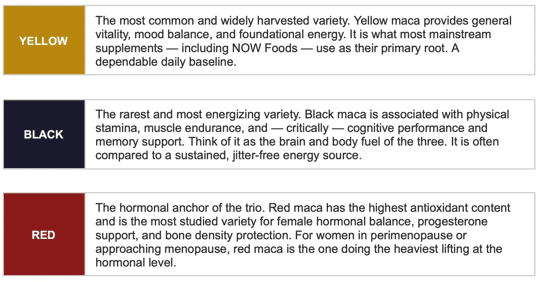
Most of the maca products you will find on general supplement shelves are yellow. Not because the others are less valuable – but because yellow is the most abundant and least expensive to produce at scale. When you see “maca” without a color designation, you are almost always getting yellow.
The Switch: From NOW Foods to NaturaLife Labs
Here is the honest breakdown of where I was and where I moved:
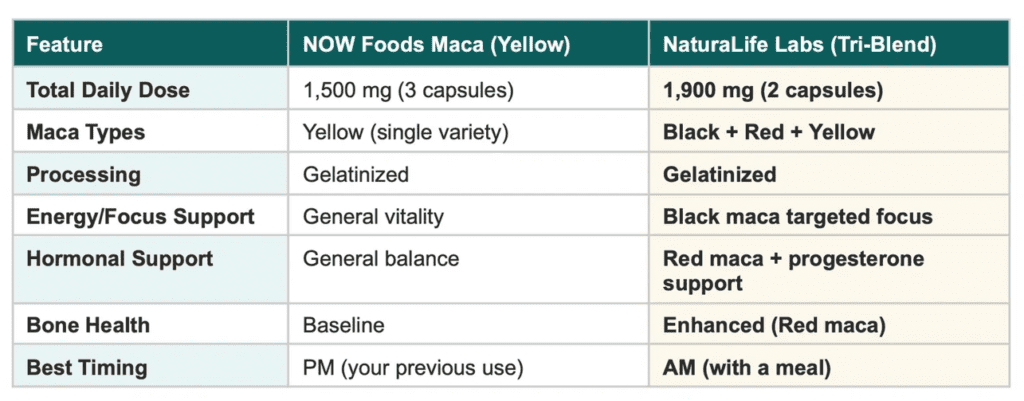
I had been taking 3 capsules of NOW Foods Maca in the evening, totaling 1,500 mg of yellow root daily. It is a clean, hypoallergenic product that I respected. But when I looked at the full picture – that at 52 I am still cycling, strength training 4 to 5 days a week, following a keto-Ayurvedic lifestyle, and paying close attention to hormonal patterns – I realized I was leaving support on the table.
NaturaLife Labs Organic Maca Tri-Blend gives me 1,900 mg daily in just 2 capsules, with all three color varieties, gelatinized for optimal digestion and bioavailability. The shift is strategic, not random.
Why I Made the Timing Switch: Evening to Morning
This is a small but meaningful detail. I was taking maca in the evening. Moving to the NaturaLife Labs blend meant moving my dose to the morning – and here is why that matters:
- Black maca is energizing. Taking a stimulating adaptogen at night risks disrupting sleep quality, especially during the luteal phase when the nervous system is already more sensitive.
- Morning dosing allows the HPA axis to receive its adaptogenic signal at the start of the day, which means the hormonal and cognitive benefits build through your most active hours.
- Taking it with a morning meal – ideally with a healthy fat on a keto protocol – maximizes absorption and gives the gelatinized formula the digestive environment it performs best in.
The maca’s cumulative effect means the body maintains its “reserve” through the evening even when dosed in the morning. So sleep support is not compromised – it is actually protected by keeping the stimulating black maca out of your PM routine.
Maca and Your Cycle: A Phase-by-Phase View
For those of us who are still cycling and doing the work of cycle-syncing our movement, nutrition, and supplementation, here is how the NaturaLife Labs Tri-Blend slots into each phase:
Follicular Phase (Day 1 through Ovulation)
This is your high-energy window. Estrogen is rising, insulin sensitivity is at its peak, and your body is primed for strength and focus. The black maca shines here – amplifying the mental sharpness and physical stamina you naturally have more access to during this phase. On a keto-Ayurvedic protocol, pair this phase with cooler, lighter fats like avocado and coconut to balance the energizing, slightly “heating” quality of black maca.
Luteal Phase (Post-Ovulation through Day 1)
This is where the red maca becomes your most important ally. As progesterone rises and then drops in the days before your period, red maca nourishes the HPA axis to support your body’s own progesterone production. For women in their 50s, the luteal phase often shortens as ovarian progesterone output decreases – which is exactly when the “wired but tired” feeling, irritability, disrupted sleep, and spotting can appear.
On a keto-Ayurvedic protocol, this is your Vata-balancing time. Warm, cooked foods, healthy fats like ghee, and grounding practices support the nervous system alongside the red maca’s hormonal steadying work. The gelatinized form is much gentler on Vata digestive fire than raw maca powder would be.
Transition Note
Because NaturaLife Labs is nearly double the potency per capsule (950 mg vs 500 mg), l recommend starting with 1 capsule in the morning for the first 3 to 5 days if you are new to this brand. Gauge how your body responds to the increased concentration of black and red strains before moving to the full 2-capsule serving.
What to Watch For: Your First Month Checklist
Because maca is cumulative, most of the real shifts happen between weeks 8 and 12. But here are early green flags and caution signs to track from day one:
Green Flags (Signs It’s Working)
- Sleep quality improves – falling asleep more easily, waking more refreshed
- Reduced anxiety or irritability in the 10 to 14 days before your period
- Stable cycle timing and flow without new spotting or sudden heaviness Sustained, clear-headed morning focus without an afternoon crash
- Reduction in bloating or breast tenderness in the luteal phase
Caution Signs (Dose May Be Too High)
- New insomnia or feeling wired at bedtime after your AM dose
- Increased heart palpitations or mild jitteriness
- Cycle starting several days earlier than your normal pattern
If any of these appear, simply drop to 1 capsule (950 mg) for a few days. Because the formula is still working at the foundational HPA level, you will not lose your progress – you are simply fine-tuning the dose to where your body is most comfortable
Amplifying the Effect: Ayurvedic Herbs for Joint Recovery and Hormonal Support
If you are combining maca with a progressive overload training program and yoga practice – as I do – these four Ayurvedic rasayanas (rejuvenating herbs) work synergistically with the maca to protect your joints, reduce inflammation, and support long-term hormonal resilience:
Turmeric (Haridra) with Black Pepper
Curcumin, turmeric’s active compound, is a potent anti-inflammatory that speeds the repair of micro-tears in muscle fibers and reduces joint stiffness after heavy lifting sessions. Because curcumin is fat-soluble, consuming it alongside your keto fats – ghee, avocado, or MCT oil – with a pinch of black pepper dramatically increases absorption.
Ashwagandha (Withania Somnifera)
Where maca is energizing, ashwagandha is calming. Together they create endocrine balance – supporting cortisol regulation and progesterone levels simultaneously. I recommend taking ashwagandha in the evening to support the deep, restorative sleep your joints need for repair while the maca does its AM work.
Ginger (Shunthi)
Ayurveda calls ginger “the universal medicine” for good reason. It improves circulation to the joints, enhances digestive fire (Agni), and acts as a carrier herb that helps the gelatinized maca absorb even more efficiently. This is particularly supportive during the Vata-dominant luteal phase.
Boswellia (Shallaki)
Often called Indian Frankincense, boswellia contains boswellic acids that specifically block the enzymes responsible for attacking joint tissue. For women over 50 who are doing consistent weight training and yoga, this is a quiet but powerful protector of long-term joint health.
Recovery Elixir Recipe
Warm 1 cup coconut milk or water. Add 1/2 tsp turmeric, 1/2 tsp ginger, and a pinch of black pepper. Stir in 1 tsp ghee or MCT oil to carry the curcumin. Sip warm alongside your morning maca capsules. This is your joint recovery ritual, your digestive fire igniter, and your Vata-pacifying morning anchor all in one cup.
The Bottom Line: Your Supplement Protocol Should Evolve With You
I did not switch brands because something was wrong. I switched because I was listening. Because I paid attention to where I am in my hormonal arc at 52 – still cycling, still building, still learning my body’s evolving language – and I asked whether my current supplement protocol was meeting that arc or just maintaining a habit.
The answer was that a more targeted, full-spectrum maca was a smarter fit for this season. And that is the whole philosophy behind the keto-Ayurvedic approach to midlife wellness: we are not chasing what we had at 30. We are becoming something more sophisticated, more attuned, and more intentional at 50 and beyond.
Your body is not failing. It is evolving. And the wisest thing you can do is evolve your support alongside it.
That is the Focus Female Method™ in practice. Reclaim. Redesign. Reign.
Ready to Know Your Dosha?
Every supplement protocol works better when it’s tailored to your constitution. If you want to understand whether you’re Vata, Pitta, or Kapha – and how that shapes everything from your hormonal experience to your ideal keto-Ayurvedic food choices – I invite you to take the Dosha Discovery Quiz at futurefocusfemale.com.
Follow along: @futurefocusfemale
FutureFocusFemale #MacaForWomen #KetoPerimenopause #AyurvedicWellness CycleSyncing #HormoneHealth #TriColorMaca #FocusFemaleMethod
Disclaimer
The information shared on this website and in all Future Focus Female LLC content is intended for educational and informational purposes only. It is not a substitute for professional medical advice, diagnosis, or care. Kimberly Curtis is a Certified Ayurvedic Life Coach, Certified Yoga Instructor, iPEC Energy Leadership Coach, Culinary Chef, Integrative Wellness Educator, and Perimenopause Protocol Designer- not a licensed medical professional. Always consult your qualified healthcare provider before beginning any new supplement, wellness protocol, or lifestyle change, particularly if you are pregnant, nursing, managing a medical condition, or taking prescription medications. Individual results vary.
Some links in this post may be affiliate links. Future Focus Female LLC may earn a small commission at no additional cost to you. I only recommend products I personally research and stand behind.
C 2026 Future Focus Female LLC | futurefocusfemale.com | @futurefocusfemale
STANDARD AUTHOR BYLINE
By Kimberly Curtis | Future Focus Female
Certified Ayurvedic Life Coach . Integrative Wellness Educator · Perimenopause Protocol Designer
